Showing posts with label underground. Show all posts

Saturday

Totley Tunnel and Cavern

Pic by fishbrain

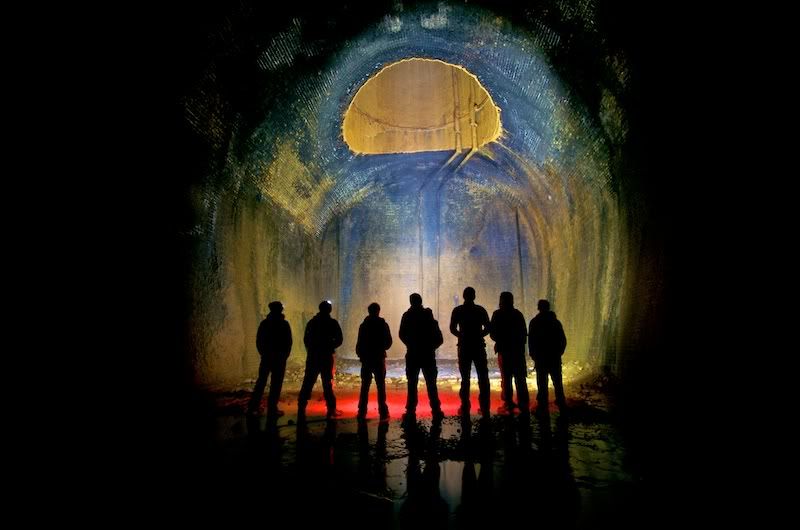
“What you doing there lads?” It must have been an unusual encounter for the train conductor. Four faces pressed against the window of the train, each of us holding a torch and shining it into the darkness of the second longest train tunnel in the UK. This was more than a year ago. We were on our way to Sheffield and had heard about a large natural cavern, hidden somewhere half way along the Totley railway tunnel. Unsurprisingly we didn’t manage to spot any such feature. The train was moving too fast and we were sat on the wrong side of the carriage.

Read More......

Friday

Errwood Plughole Abseil + Woodhead Tunnel

© Gone
 After two very sunny and warm weeks, the rain had come back to England. It was cold, windy, and just very very wet, just one of these days you retreat to your sofa and drink some warm tea.

Read More......

Sheffield II, Firth Brown Medical Centre


This is the weirdest underground place I have ever been to, mainly as it hasn't always been underground.


Firth Brown was one of the steelwork giants in Sheffield, with the medical centre there to look after any injured workers from the factories. 
There is no information on when it closed down, but the picture to the right suggests it was still open in 1956. 


What makes this place so special is the fact that the building was never demolished once the doors were closed. Instead a wall was build around the whole complex. The top was then filled up with gravel and it now serves as a car park raised a storey above the road. The reasons for this I can not understand.


I have been in many underground locations and it's always a little worrying thinking about the tonnes of soil sitting just a metre above you. But in this case it was even worse, as only an 80 year old ceiling of a small building was holding up this weight it was never designed for. 


The place isn't very big, but with its history and also the ingenious access it was definitely worth a look.


Read More......

Tuesday

Standedge Tunnel


Its a Sunday afternoon in the Peak District. Gone, NickUK and myself are lying low in the darkness. The torches have been switched off. The tripods weighed down. The exposures and apertures are set. 
Most people who made their way into the peaks on this Sunday are either walking in the hills or escaping the rain in a warm pub. But not us.

The wind is slowly picking up. The two light beams are coming closer and the rails are starting to vibrate. 
Maybe another few seconds. 


Suddenly the noise of the engine and the squeaking of the wheels is reaching us. The three shutters are opened in anticipation of the two seconds that we have been waiting for some time.
A last push of air and the train passes the small arch we are hiding in. A few seconds later and we can see the rear lights leaving the tunnel at some speed. 


The adrenaline is slowly dropping again and we realise that a few hundred tonnes of steel have just moved past us at a distance of just a meter. 
The shutters are closed and we compare our pictures. The tripods are moved and we wait for the next train.


We are in the standedge tunnels, sat next to the only one left that is still in operation. 
The standedge tunnels are four parallel tunnels that run beneath the Pennines. They consist of two disused rail tunnels, followed by a canal tunnel and the live tunnel. It is 5,029 metres (16,499 ft) long and 194 metres (636 ft) underground at the deepest point, making it the longest, deepest and highest canal tunnel in the UK.

The canal tunnel was the first of the four constructed. Work begun in 1794 supervised by a young and inexperienced surveyor. 123 thousand pounds and 17 years later, in 1811, the canal was opened and was used by an average of 40 boats a day. In 1921 the last boat passed through the tunnel and in 1944 it was officially closed, as parts of it had collapsed and blocked the way. In 2001 a 5 million pound restoration project was started and since 2009 boats can pass through again.


 The three rail tunnels were built in 1848, 1871 and 1894, with the last one still in operation today. The construction of the tunnels was eased through the canal as the stone could be driven out on boats.  The rail tunnels are level for their whole length providing the only section of level track on the line where water troughs could be installed to provide steam locomotives with fresh water supplies without the requirement for the train to stop.
The two smaller rail tunnels are still maintained and are used as an emergency escape for the train tunnel as well as an emergency route for ambulances and fire trucks.


We walked the tunnel back and forth. The 10km took us a good 4 hours and were an amazing end to a very eventful weekend. Shouts to NickUK and Gone for the awesome time and the scary moments in the car.


Read More......
Victoria arches / Cathedral Steps, Mcr (revisited)

By some referred to as the holy grail of Manchester, the cathedral steps are a set of arches underneath the Manchester city centre next to the river Irwell. The rather difficult access (including the battle with local pigeons) means that they are still in a very good condition.
I first visited this place a number of months ago together with Appo, you can see the pictures from that visit here. Back then I only owned a compact camera with a maximum exposure time of 30 seconds when set to "starry sky". So when I heard that Jimmy hadn't been down there yet and really wanted to pay the arches a visit, it was the perfect excuse to go back and take some more pics.


The arches were constructed in 1838 when a new embankment along the Irwell was build for a new road. The gained underground space was initially used by various industrial companies.

In the 1890s the Manchester ship canal company was trying to encourage passenger traffic on its waterways. 2 Landing stages were built which can be seen in the picture to the right taken from the Manchester Library.

Steamers were taking up to 1000 passengers around the Manchester docks whilst being entertained by musicians. Especially during the holiday periods these tours were very successful, with more than 200 000 passengers in the first half of 1897experiencing the boat ride.

Repeated flooding of the Irwell resulted in damage to the wooden staircases which led to the closure of the arches in 1906.


Public toilets, which could be accessed through stairs on street level next to the cathedral form part of the underground network. Whilst the female toilets have been removed, the gents are still standing. They were closed to the public in 1967, marking the final closure of the arches to the public.


During World War II the stages and tunnels surrounding them were converted into air-raid shelters. The conversion, which included additional brick blast walls, took three months at a cost of £10,150 and provided shelter for 1,619 people.


Shouts to Gone and Jimmy.

Read More......

Sunday

Schee Tunnel (Kauz U-Verlagerung)

The Schee Tunnel is a 721 meter long train tunnel in the north of wuppertal, germany. The first of the two tunnels was build in 1884 as part of the singletrack coaltrain from barmen to hattingen. In 1902, a second tunnel was build just next to it due to increasing use of the train tracks. Tracks however were never laid in the extension. Both tunnels are about 5 meter high and wide and slightly bend to the right which makes it impossible to see from one end to the other.

IMG_1076

During the second world war many tunnel and mines in germany were changed into small factories making war industry safe from attacks. The Schee tunnel was one of these U-Verlagerungen and as it was a train tunnel, gotthe codename Kauz, a birdname.
After three months of work the tunnel was converted and from August 1944 till March 1945 it was used by the company Homan for the assembly of the jet-powered fighter aircraft "Messerschmitt Me 262".
For this only the newer of the two tunnels was used. The other one was used as a ventilation shaft and access point. Today you can still see rests of the ventilation, the power cables, the supports of the cranes and the office.
In 1984 the tunnel were closed. Bats have been using it as a sleeping place and there are plans to convert it into an extension of the bicycle track through NRW.

2
IMG_1076

3
IMG_1076
One of the two offices which also connect the two tunnel

4
IMG_1076

5
IMG_1076

6
IMG_1076
The power cables were laying in these channels and converted to a lower voltage inside the middle of the tunnel.

7
IMG_1076
One of the many ventilation points which exist between the two tunnel.

Some more here: The whole set

Shouts to the befahrer crew.

Read More......

Friday

German Military Underground Hospital, Guernsey

History:
from: http://www.bbc.co.uk/guernsey/content/articles/2004/07/20/german_military_underground_hospital_about_feature.shtml

The german underground hospital and ammunition store is the largest remaining structure from the Occupation in the Channel Islands. Almost invisible from the surface the tunnel complex covers 7000 square metres.

IMG_1076
taken from bbc

Construction started in the winter of 1940 - the first winter of the Occupation.
The tunnels were dug out by hundreds of slave workers from France, Spain, Morocco, Algeria, Belgium, Holland, Poland, Russia and Guernsey.

To dig the tunnels the workers had to use not only explosives and pneumatic drills but picks, shovels, sledge hammers and bare hands.The German Military Underground Hospital and Ammunition Store took three and a half years of work before it was ready.
Work stopped when the D-Day battle began. Parts of the bunker have never been finished, and there are still visible two tunels that got started but have never been finished.

There were three tunnel entrances and five ventilation shafts with iron ladders or concrete steps so they could be used as emergency exits.
They range in depth from 45 feet to 75 feet. The 75 foot shaft has a reservoir dug into one side which could hold thousands of gallons of water.


Was only there for half an hour without any equipment hence the slight blurryness in some.


1
IMG_1076

2
IMG_1076
this room was once full of beds

3
IMG_1076
here they are slowly rusting away

4
IMG_1076

5
IMG_1076

6
IMG_1076

7


8
IMG_1076
the kitchen

9
IMG_1076
a whole room in a bunker full of wine?

10
IMG_1076

Read More......

Tuesday

Cathedral Steps, Manchester

So far the most amazing place i have been to. Visited with Appo
revisited in november 2011: click here
The Victoria Arches were a series of arches built in the embankment of the River Irwell in Manchester. They served as business premises, landing stages for Steam packet riverboats, and also as World War II air-raid shelters. They were accessed from wooden staircases which descended from Victoria Street.

P1050018

Regular flooding of the river resulted in the closure of the steam-packet services in the early 20th century, and the arches were used for general storage. In World War II the arches were converted for use as air raid shelters. The arches are now bricked up and inaccessible; the staircases were removed in the latter part of the 20th century.

P1050031

P1050005

P1050007

P1050027

P1050032

P1050042

The whole set

Read More......